 Add to Chrome
 Add to Firefox
 Add to Edge
Dexterity-BEV: Aligning 3D World and Actions for Generalizable Robot Policies Learning
Jun 01, 2026
End-to-end manipulation policies, combined with web-scale pretrained Vision-Language Models (VLMs), show the promise for generalizable and dexterous robotic manipulation. However, they inherit two key limitations from 2D foundation models: 1) the reliance on 2D RGB inputs that ignores the intrinsically 3D nature of manipulation; and 2) the lack of spatial 3D alignment between input-output spaces as well as across diverse robot embodiments, camera setups, and trajectory datasets. In this paper, we present a series of contributions to address these issues. First, we introduce aligned vertex map and vertex spectrum -- a pixel-wise 3D representation that elevates 2D visual inputs to 3D, using camera calibration and optional depth. This novel input representation marries 3D awareness with the generalization of 2D large VLMs. Then, we propose to align the inputs and outputs of manipulation policies by expressing per-pixel 3D information of each camera view and robot actions to a shared coordinate. Based on this, we designate a canonical Bird's-Eye-View (BEV) alignment frame and innovatively propose to construct BEV images, producing a view-invariant representation robust to camera pose variations. To enable training and evaluation at scale, we develop a comprehensive data processing pipeline to perform such alignments; we also introduce a novel temporal alignment scheme for trajectories across diverse robots, human operators, and datasets. These contributions collectively mitigate input and output spatial-temporal misalignments, improving the consistency and generalization for real-world manipulation. Pretrained checkpoint, source code and data processing pipeline are available in https://hnuzhy.github.io/projects/Dex-BEV.

EHRBench: An Automated and Reliable EHR-based Benchmark for Clinical Decision Making with LLMs
May 28, 2026Clinical decision-making (CDM) is central to real-world clinical workflows, where clinicians infer diagnoses, select treatments, or anticipate future health outcomes under incomplete evidence. LLMs are increasingly used to support these decisions due to strong language capabilities, broad biomedical knowledge, and efficiency, yet the reliability of LLMs on real-world clinical decision tasks remains insufficiently understood. To evaluate CDM models, especially LLM-based models, an ideal and practical medical decision benchmark should be constructed via an automated yet reliable pipeline to ensure both scale and quality. Moreover, the grounding of a CDM benchmark in real patient EHRs can better support evaluation on practical CDM tasks that require substantive biomedical knowledge and clinical inference. To fill the gaps, we introduce EHRBench, an automated and reliable EHR-grounded benchmark for evaluating LLM-based clinical decision-making at scale. To ensure scalability and reliability, EHRBench is constructed through an EHR-LLM-KB(knowledge-base) interaction pipeline. For efficiency, we use a specialized LLM to automatically convert encounter-level EHR trajectories into structured templates and deterministically instantiate the templates into QA items. In parallel, we apply systematic KB-based verification and enrichment to filter hallucinated or ambiguous relations and to improve reliability. Using this pipeline, we construct nearly 1M (960,067) QA items spanning three core inference-required clinical decision tasks: diagnosis, treatment, and prognosis. We benchmark more than 30 representative LLMs on EHRBench and provide detailed analyses of performance and robustness. The results show consistent capability trends across settings, further validating the reliability of EHRBench and highlighting actionable gaps toward clinically reliable LLM systems.
MDPBench: A Benchmark for Multilingual Document Parsing in Real-World Scenarios
Mar 30, 2026We introduce Multilingual Document Parsing Benchmark, the first benchmark for multilingual digital and photographed document parsing. Document parsing has made remarkable strides, yet almost exclusively on clean, digital, well-formatted pages in a handful of dominant languages. No systematic benchmark exists to evaluate how models perform on digital and photographed documents across diverse scripts and low-resource languages. MDPBench comprises 3,400 document images spanning 17 languages, diverse scripts, and varied photographic conditions, with high-quality annotations produced through a rigorous pipeline of expert model labeling, manual correction, and human verification. To ensure fair comparison and prevent data leakage, we maintain separate public and private evaluation splits. Our comprehensive evaluation of both open-source and closed-source models uncovers a striking finding: while closed-source models (notably Gemini3-Pro) prove relatively robust, open-source alternatives suffer dramatic performance collapse, particularly on non-Latin scripts and real-world photographed documents, with an average drop of 17.8% on photographed documents and 14.0% on non-Latin scripts. These results reveal significant performance imbalances across languages and conditions, and point to concrete directions for building more inclusive, deployment-ready parsing systems. Source available at https://github.com/Yuliang-Liu/MultimodalOCR.
Dialogue to Question Generation for Evidence-based Medical Guideline Agent Development
Mar 25, 2026Evidence-based medicine (EBM) is central to high-quality care, but remains difficult to implement in fast-paced primary care settings. Physicians face short consultations, increasing patient loads, and lengthy guideline documents that are impractical to consult in real time. To address this gap, we investigate the feasibility of using large language models (LLMs) as ambient assistants that surface targeted, evidence-based questions during physician-patient encounters. Our study focuses on question generation rather than question answering, with the aim of scaffolding physician reasoning and integrating guideline-based practice into brief consultations. We implemented two prompting strategies, a zero-shot baseline and a multi-stage reasoning variant, using Gemini 2.5 as the backbone model. We evaluated on a benchmark of 80 de-identified transcripts from real clinical encounters, with six experienced physicians contributing over 90 hours of structured review. Results indicate that while general-purpose LLMs are not yet fully reliable, they can produce clinically meaningful and guideline-relevant questions, suggesting significant potential to reduce cognitive burden and make EBM more actionable at the point of care.
* 9 pages. To appear in Proceedings of Machine Learning Research (PMLR), Machine Learning for Health (ML4H) Symposium 2025
SparseDVFS: Sparse-Aware DVFS for Energy-Efficient Edge Inference
Mar 23, 2026Deploying deep neural networks (DNNs) on power-sensitive edge devices presents a formidable challenge. While Dynamic Voltage and Frequency Scaling (DVFS) is widely employed for energy optimization, traditional model-level scaling is often too coarse to capture intra-inference variations, whereas fine-grained operator-level scaling suffers from prohibitive performance degradation due to significant hardware switching latency. This paper presents SparseDVFS, a fine-grained, sparse-aware DVFS framework designed for energy-efficient edge inference. Our key insight is that operator sparsity is a primary metric for hardware frequency modulation. By distinguishing between compute-bound dense operators and memory-bound sparse operators, the system can apply specialized frequency triplets to maximize energy efficiency. To overcome switching overheads and component interference, SparseDVFS incorporates three key innovations: (1) an offline modeler that established a deterministic mapping between operator sparsity and optimal frequency triplets (CPU/GPU/EMC) via white-box timeline analysis; (2) a runtime graph partitioner that utilizes a greedy merging heuristic to aggregate operators into super-blocks, balancing scaling granularity and DVFS switching latency through a latency amortization constraint; and (3) a unified co-governor that employs a frequency unified scaling engine (FUSE) and a look-ahead instruction queue to eliminate antagonistic effects between independent controllers and hide hardware transition latencies. Extensive evaluations show that SparseDVFS achieves an average 78.17% energy efficiency gain over state-of-the-art solutions while maintaining a superior 14% cost-gain ratio.
RelayGR: Scaling Long-Sequence Generative Recommendation via Cross-Stage Relay-Race Inference
Jan 05, 2026Real-time recommender systems execute multi-stage cascades (retrieval, pre-processing, fine-grained ranking) under strict tail-latency SLOs, leaving only tens of milliseconds for ranking. Generative recommendation (GR) models can improve quality by consuming long user-behavior sequences, but in production their online sequence length is tightly capped by the ranking-stage P99 budget. We observe that the majority of GR tokens encode user behaviors that are independent of the item candidates, suggesting an opportunity to pre-infer a user-behavior prefix once and reuse it during ranking rather than recomputing it on the critical path. Realizing this idea at industrial scale is non-trivial: the prefix cache must survive across multiple pipeline stages before the final ranking instance is determined, the user population implies cache footprints far beyond a single device, and indiscriminate pre-inference would overload shared resources under high QPS. We present RelayGR, a production system that enables in-HBM relay-race inference for GR. RelayGR selectively pre-infers long-term user prefixes, keeps their KV caches resident in HBM over the request lifecycle, and ensures the subsequent ranking can consume them without remote fetches. RelayGR combines three techniques: 1) a sequence-aware trigger that admits only at-risk requests under a bounded cache footprint and pre-inference load, 2) an affinity-aware router that co-locates cache production and consumption by routing both the auxiliary pre-infer signal and the ranking request to the same instance, and 3) a memory-aware expander that uses server-local DRAM to capture short-term cross-request reuse while avoiding redundant reloads. We implement RelayGR on Huawei Ascend NPUs and evaluate it with real queries. Under a fixed P99 SLO, RelayGR supports up to 1.5$\times$ longer sequences and improves SLO-compliant throughput by up to 3.6$\times$.
MonkeyOCR v1.5 Technical Report: Unlocking Robust Document Parsing for Complex Patterns
Nov 16, 2025Document parsing is a core task in document intelligence, supporting applications such as information extraction, retrieval-augmented generation, and automated document analysis. However, real-world documents often feature complex layouts with multi-level tables, embedded images or formulas, and cross-page structures, which remain challenging for existing OCR systems. We introduce MonkeyOCR v1.5, a unified vision-language framework that enhances both layout understanding and content recognition through a two-stage pipeline. The first stage employs a large multimodal model to jointly predict layout and reading order, leveraging visual information to ensure sequential consistency. The second stage performs localized recognition of text, formulas, and tables within detected regions, maintaining high visual fidelity while reducing error propagation. To address complex table structures, we propose a visual consistency-based reinforcement learning scheme that evaluates recognition quality via render-and-compare alignment, improving structural accuracy without manual annotations. Additionally, two specialized modules, Image-Decoupled Table Parsing and Type-Guided Table Merging, are introduced to enable reliable parsing of tables containing embedded images and reconstruction of tables crossing pages or columns. Comprehensive experiments on OmniDocBench v1.5 demonstrate that MonkeyOCR v1.5 achieves state-of-the-art performance, outperforming PPOCR-VL and MinerU 2.5 while showing exceptional robustness in visually complex document scenarios. A trial link can be found at https://github.com/Yuliang-Liu/MonkeyOCR .
TOM: An Open-Source Tongue Segmentation Method with Multi-Teacher Distillation and Task-Specific Data Augmentation
Aug 19, 2025Tongue imaging serves as a valuable diagnostic tool, particularly in Traditional Chinese Medicine (TCM). The quality of tongue surface segmentation significantly affects the accuracy of tongue image classification and subsequent diagnosis in intelligent tongue diagnosis systems. However, existing research on tongue image segmentation faces notable limitations, and there is a lack of robust and user-friendly segmentation tools. This paper proposes a tongue image segmentation model (TOM) based on multi-teacher knowledge distillation. By incorporating a novel diffusion-based data augmentation method, we enhanced the generalization ability of the segmentation model while reducing its parameter size. Notably, after reducing the parameter count by 96.6% compared to the teacher models, the student model still achieves an impressive segmentation performance of 95.22% mIoU. Furthermore, we packaged and deployed the trained model as both an online and offline segmentation tool (available at https://itongue.cn/), allowing TCM practitioners and researchers to use it without any programming experience. We also present a case study on TCM constitution classification using segmented tongue patches. Experimental results demonstrate that training with tongue patches yields higher classification performance and better interpretability than original tongue images. To our knowledge, this is the first open-source and freely available tongue image segmentation tool.
KERAP: A Knowledge-Enhanced Reasoning Approach for Accurate Zero-shot Diagnosis Prediction Using Multi-agent LLMs
Jul 03, 2025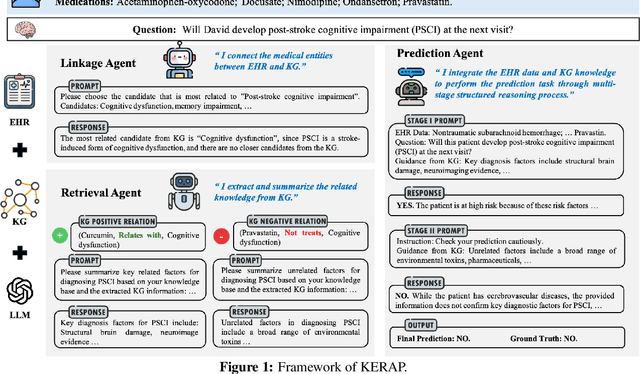
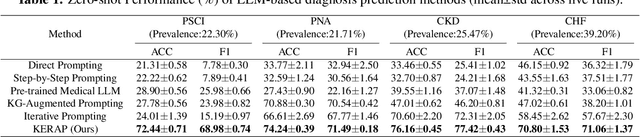

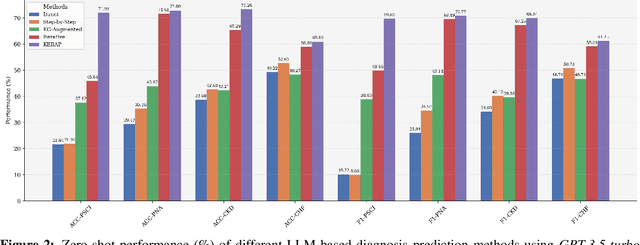
Medical diagnosis prediction plays a critical role in disease detection and personalized healthcare. While machine learning (ML) models have been widely adopted for this task, their reliance on supervised training limits their ability to generalize to unseen cases, particularly given the high cost of acquiring large, labeled datasets. Large language models (LLMs) have shown promise in leveraging language abilities and biomedical knowledge for diagnosis prediction. However, they often suffer from hallucinations, lack structured medical reasoning, and produce useless outputs. To address these challenges, we propose KERAP, a knowledge graph (KG)-enhanced reasoning approach that improves LLM-based diagnosis prediction through a multi-agent architecture. Our framework consists of a linkage agent for attribute mapping, a retrieval agent for structured knowledge extraction, and a prediction agent that iteratively refines diagnosis predictions. Experimental results demonstrate that KERAP enhances diagnostic reliability efficiently, offering a scalable and interpretable solution for zero-shot medical diagnosis prediction.
MonkeyOCR: Document Parsing with a Structure-Recognition-Relation Triplet Paradigm
Jun 05, 2025We introduce MonkeyOCR, a vision-language model for document parsing that advances the state of the art by leveraging a Structure-Recognition-Relation (SRR) triplet paradigm. This design simplifies what would otherwise be a complex multi-tool pipeline (as in MinerU's modular approach) and avoids the inefficiencies of processing full pages with giant end-to-end models (e.g., large multimodal LLMs like Qwen-VL). In SRR, document parsing is abstracted into three fundamental questions - "Where is it?" (structure), "What is it?" (recognition), and "How is it organized?" (relation) - corresponding to layout analysis, content identification, and logical ordering. This focused decomposition balances accuracy and speed: it enables efficient, scalable processing without sacrificing precision. To train and evaluate this approach, we introduce the MonkeyDoc (the most comprehensive document parsing dataset to date), with 3.9 million instances spanning over ten document types in both Chinese and English. Experiments show that MonkeyOCR outperforms MinerU by an average of 5.1%, with particularly notable improvements on challenging content such as formulas (+15.0%) and tables (+8.6%). Remarkably, our 3B-parameter model surpasses much larger and top-performing models, including Qwen2.5-VL (72B) and Gemini 2.5 Pro, achieving state-of-the-art average performance on English document parsing tasks. In addition, MonkeyOCR processes multi-page documents significantly faster (0.84 pages per second compared to 0.65 for MinerU and 0.12 for Qwen2.5-VL-7B). The 3B model can be efficiently deployed for inference on a single NVIDIA 3090 GPU. Code and models will be released at https://github.com/Yuliang-Liu/MonkeyOCR.